Blog

Measurable Transport Quality: A Closer Look at Our 2026 Standards
In the logistics sector, guesswork isn’t an option. True growth demands that we constantly put our own processes to the test and keep an open, honest dialogue with those who trust us with their cargo. As a pan-European operator, handling everything from express road freight to global air charters, we at Euro24 see our customers‘ feedback as our main driver of change and a core part of our strategic planning. Evaluating our performance and staying close to clients in demanding sectors like automotive, aviation, chemicals, and electronics is our starting point for designing any logistics process. We know that the only way to clear bottlenecks and stay ahead of your needs is to constantly measure our procedures against your real-world experience.
This is exactly why in 2026, we launched our second comprehensive Service Quality Survey, which we conduct in partnership with the University of Information Technology and Management in Rzeszow (UITM). The university’s experts are responsible for the rigorous calculations, statistical analysis, and compiling the independent report. Our goal was to dive deep into 26 key areas of our daily operations, ranging from on-time delivery to cargo security, and measure them directly against what our customers expect. By comparing the results with our 2024 data, we can do much more than just track our progress; we can map out a clear path for the years ahead.
What do logistics and procurement teams really look for in a carrier in 2026?
A few years back, a transport RFP was simple: rates, lead times, and insurance. Today, manufacturing procurement teams expect a whole lot more. They want to see real-world on-time delivery (OTD) rates, guaranteed response times for inquiries, proactive tracking updates, and clear contingency plans for delays. On top of that, carbon footprint data for ESG reporting is fast becoming a standard requirement. And perhaps most importantly: they want to know if a carrier actually measures client satisfaction and what they do with those insights.
This isn’t just a minor shift. In automotive and aviation, just-in-time and just-in-sequence logistics leave zero margin for error. A single delayed shipment can halt an entire assembly line, racking up tens of thousands of euros in downtime costs per hour, making the actual freight rate look like pocket change. That’s why modern logistics managers are looking for predictability. They need a partner whose service quality is backed by hard data long before any contract is signed.
The TSL Market Under Pressure: Driver Shortages, New Regulations, and Skyrocketing Standards
Maintaining reliability in 2026 is no easy task for carriers. According to the IRU, Europe faced a massive shortage of 426,000 professional drivers back in 2024. Today, that gap is only widening, with roughly 30% of EU drivers now over the age of 50. Adding to the strain is a wave of new regulations hitting the industry all at once:
- Stricter ADR regulations (effective June 24, 2026) introduce a new risk classification that impacts the entire supply chain, from shippers to consignees.
- Smart G2V2 tachographs (mandatory since July 1, 2026) are now required for international vans between 2.5 and 3.5 tonnes, bringing them under strict driver hours rules.
- A new mileage tax in the Netherlands (effective July 1, 2026) has replaced the Eurovignette for trucks.
- New GSR safety requirements (mandatory since July 7, 2026) require all new trucks in the EU to feature advanced safety systems (like AEB, ISA, LDW, and EDR).
At the same time, the IRU noted a 6% drop in new truck registrations across the EU in 2025. When you couple that with the rising cost pressures of the ETS2 system, it is clear some carriers will struggle just to keep their fleets running and maintain basic service standards. Industry analysts are calling it: in 2026, the winners won’t be the cheapest, but the most predictable. Meanwhile, customer expectations around on-time performance, instant delivery proofs, and data transparency keep climbing. (source: Bibby Financial Services, transport in 2026, trans.info, transport in Europe, TruckFocus.pl, transport in 2026, and trans.info, changes in transport in 2026)
Why „Premium Service“ Promises Are No Longer Enough
Just about every transport and logistics provider promises „top-tier quality“ and a „tailored approach.“ But the problem with these claims is that they are virtually impossible to measure, let alone compare. Meanwhile, manufacturing companies now expect the same from their logistics partners as they do from their component suppliers: hard, auditable data.
Running regular, scientifically backed service quality audits is still a rarity in the Polish freight forwarding market. At Euro24, we conduct this comprehensive study every two years. We treat the findings as a genuine quality management tool, not just another piece of marketing collateral. Here is a look at how our methodology works in practice and what the 2026 results actually reveal
The SERVQUAL Method: – How We Measure Transport Service Quality?
SERVQUAL is a service quality measurement method developed in the 1980s by researchers A. Parasuraman, V. Zeithaml, and L. Berry. Its foundation is simple: service quality does not exist in isolation from customer expectations. The exact same delivery completed in 24 hours will be rated completely differently by a customer who expected it within 48 hours, and differently by one who was promised it in 12 hours. That is why SERVQUAL measures two things at once. Firstly: what the customer expects from a benchmark provider. Secondly: how they rate the actual service of the surveyed company. For four decades, this method has been successfully used, among others, in banking, healthcare, or logistics, allowing for a reliable comparison of results between companies, industries, and subsequent years.
Five Dimensions of Transport Service Quality
The SERVQUAL questionnaire groups criteria into five dimensions. In the Euro24 survey, each dimension has an assigned weight. The weights are identical in both editions, which allows for comparing the results:
| Quality dimension | What it covers in transport | Weight |
|---|---|---|
| Reliability | on-time deliveries, compliance with order terms, response time, cargo security | 0,25 |
| Responsiveness | speed of reacting to problems, status updates, transparency in case of errors, order prioritization | 0,30 |
| Trust and relationship building | buildingprofessionalism and personal culture of employees, understanding the customer’s industry, quality certificates held | 0,20 |
| Empathy and individual approach | operational availability, flexibility and adaptation of processes to customer requirements, openness to suggestions | 0,10 |
| Tangibles | company organization, brand credibility, technological resources and operational flexibility (e.g., evening valuation) | 0,15 |
Expectations vs. Experience – How to read the results?
expectations of a benchmark provider (E), and then by evaluating the actual level of Euro24 services (P). If the actual rating matches the expectations, it means that the company meets the standard recognized by the customer as a benchmark. We present the results in the most intuitive form: as a percentage of expectation fulfillment. A result of 100% means full alignment of experience with expectations, while a result above 100% indicates that our service quality exceeded the customer’s initial requirements.
How did Euro24 conduct the survey in 2026?
In the survey conducted in 2026, 73 respondents participated. The Polish version of the questionnaire was completed by 62 people, while the English version was completed by 11. The respondents were mainly representatives of logistics departments (making up 81% of the sample), representing key industries: automotive, aviation, chemical, and electronics.
This year’s questionnaire covered 26 criteria – four more than in 2024 ($N=126$). For the first time, we added dedicated sections regarding air freight, sea freight, and rail freight. Euro24 fully documents the methodology used and the sample sizes in the report – as we believe that only a transparent and verifiable study constitutes a reliable confirmation of the quality of transport services.

Service Quality Surveya Results 2026
To what extent does Euro24 meet customer expectations?
Before we move on to the ratings, let’s look at the expectations themselves. Euro24’s customers defined the benchmark provider’s level at an average of 6.4–6.7 points on a 7-point scale, and for service culture and service recommendability – even above 6.7. This is an extremely high bar. Such high ratings stem from the specifics of the industries where transport is a critical link in production. The Automotive sector operates under a strict just-in-time regime, the aviation industry handles shipments with AOG (Aircraft on Ground) status where every hour generates massive losses, and the chemical industry operates under restrictive ADR requirements. Against this backdrop, any result close to 100% means that the transport services provided are reaching the level of a market benchmark.
Key customer service areas
The table below compares the highest customer expectations with the actual rating of Euro24 services (scale 1–7, N=73):
| Service area | Customer expectations (average, scale: 1-7) | Euro24 rating (average, scale: 1-7) | Expectation fulfillment |
|---|---|---|---|
| Opportunity for evening valuation and transport execution | 5,89 | 6,01 | 102,0% |
| Quality certificates matching customer needs | 6,60 | 6,68 | 101,2% |
| Personal culture and politeness of employees | 6,73 | 6,79 | 100,9% |
| 24/7 customer availability | 6,42 | 6,48 | 100,9% |
| Tailoring to individual customer requirements | 6,59 | 6,59 | 100,0% |
| Correct identification of customer priorities | 6,59 | 6,59 | 100,0% |
| Openness to customer suggestions and feedback | 6,66 | 6,63 | 99,5% |
| Perception of the company as stable and well-organized | 6,55 | 6,52 | 99,5% |
| Understanding the specifics of the customer’s industry | 6,62 | 6,58 | 99,4% |
| Brand credibility as a partner for long-term cooperation | 6,63 | 6,58 | 99,2% |
| Recommendable road freight service | 6,70 | 6,55 | 97,8% |
Here are a few key conclusions from the summary above:
In areas related to flexibility, Euro24 exceeds the baseline expectations of our partners. This applies in particular to the possibility of evening transport valuation and 24/7 operational availability. This is a direct confirmation of the value of our Control Tower, which operates on a 24/7/365 basis, including weekends and holidays. Customers not only intensively use this service model but also rate it higher than the standard they would expect from a benchmark provid
We achieved full compliance with expectations (100%) in the areas of tailoring services to individual requirements and correctly identifying customer priorities. In the B2B service sector, this is one of the most difficult results to achieve. After all, every manufacturing client operates based on different delivery windows, specific documentation requirements, or strict delivery booking procedures.
On the other hand, relational areas stably fall within the range of 99–101% of expectation fulfillment. This applies to service culture, understanding the specifics of the customer’s industry, and our credibility as a partner for long-term cooperation. It is worth emphasizing that the initial expectations in these categories were the highest in the entire survey; therefore, keeping ratings at such a high level means providing services in full compliance with the most demanding market benchmark.


Transport Service Quality 2024 vs 2026 – What Has Changed?
The value of a cyclical survey is fully revealed during its next edition. It allows us to verify whether the corrective actions taken after the first measurement brought the expected results. A comparison of common criteria from 2024 and 2026 shows clear directions of development:
| Service area | Change 2024 – 2026 | Comment |
|---|---|---|
| Tailoring to individual customer requirements | ✔ clear improvement | rating reached full compliance with expectations (100%) |
| Perceived transport security | ✔ improvement | one of the priorities identified after the 2024 survey |
| Employee responsiveness to problems | ✔ improvement | effect of changes in procedures for handling non-standard situations |
| Personal culture and politeness of employees | ✔ improvement | above expectations in both editions of the survey |
| Trust and relationship building (entire dimension) | ✔ shift to a level above expectations | the only one of the five dimensions with a positive directional change |
| Punctuality and compliance with order terms | — stable level | constant area of monitoring and internal audits |
| Response time to inquiries | ◆ area for improvement | streamlined process of handling inquiries; area covered by the improvement plan |
The first three items in the table, which touch the very „operational heart“ of transport services, are of key importance. Transport security and the speed of reacting to problems were identified in 2024 as areas requiring reinforcement. The results from 2026 confirm that ratings in both of these criteria have clearly increased. On the other hand, flexibility in tailoring services to individual requirements has shifted to the level of full compliance with our partners‘ expectations. It is also worth noting that the entire „Trust and relationship building“ dimension was the only one to shift to a level exceeding the initial standards of our customers. This is tangible proof that our „survey → conclusions → actions → re-measurement“ model really works in practice.
Rosnące oczekiwania rynku.
Why Comparisons Require Context
When comparing both editions of the survey, one key thing must be kept in mind: the bar against which customers measure providers is systematically rising. TSL market analysts point out directly that demands regarding punctuality, instant delivery confirmations, and data transparency are growing year by year. What was a key competitive differentiator just two years ago has today become an absolute baseline standard in RFQs.
Thus, the benchmark for transport service quality is set much higher today than it was in 2024. Additionally, this year’s survey included a broader questionnaire (26 criteria instead of 22) and a different sample structure. Therefore, in areas where ratings remained unchanged, it does not mean that service quality has dropped – it simply means the point of reference has become far more demanding. This makes the areas where our ratings increased despite this shift even more valuable.
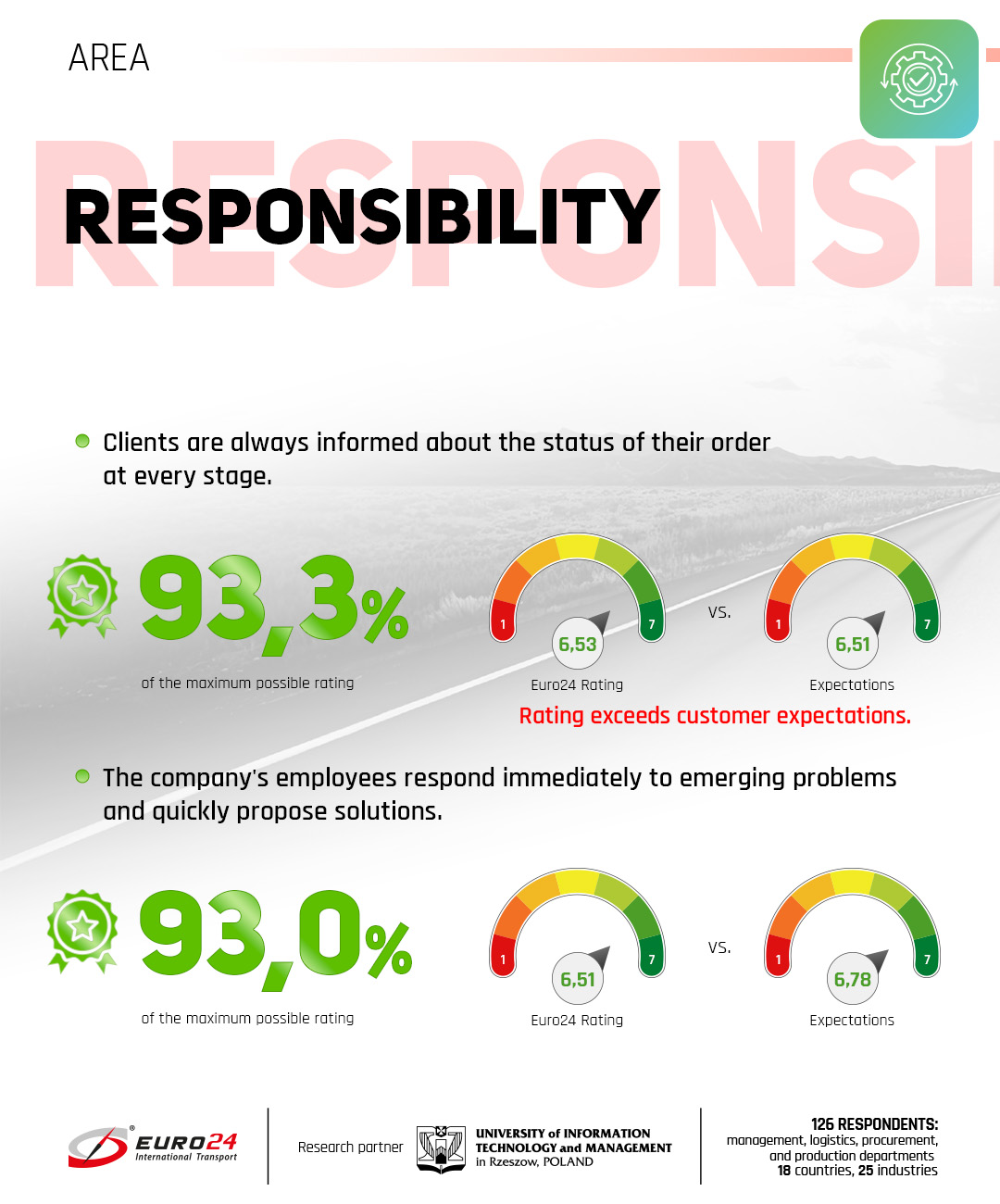
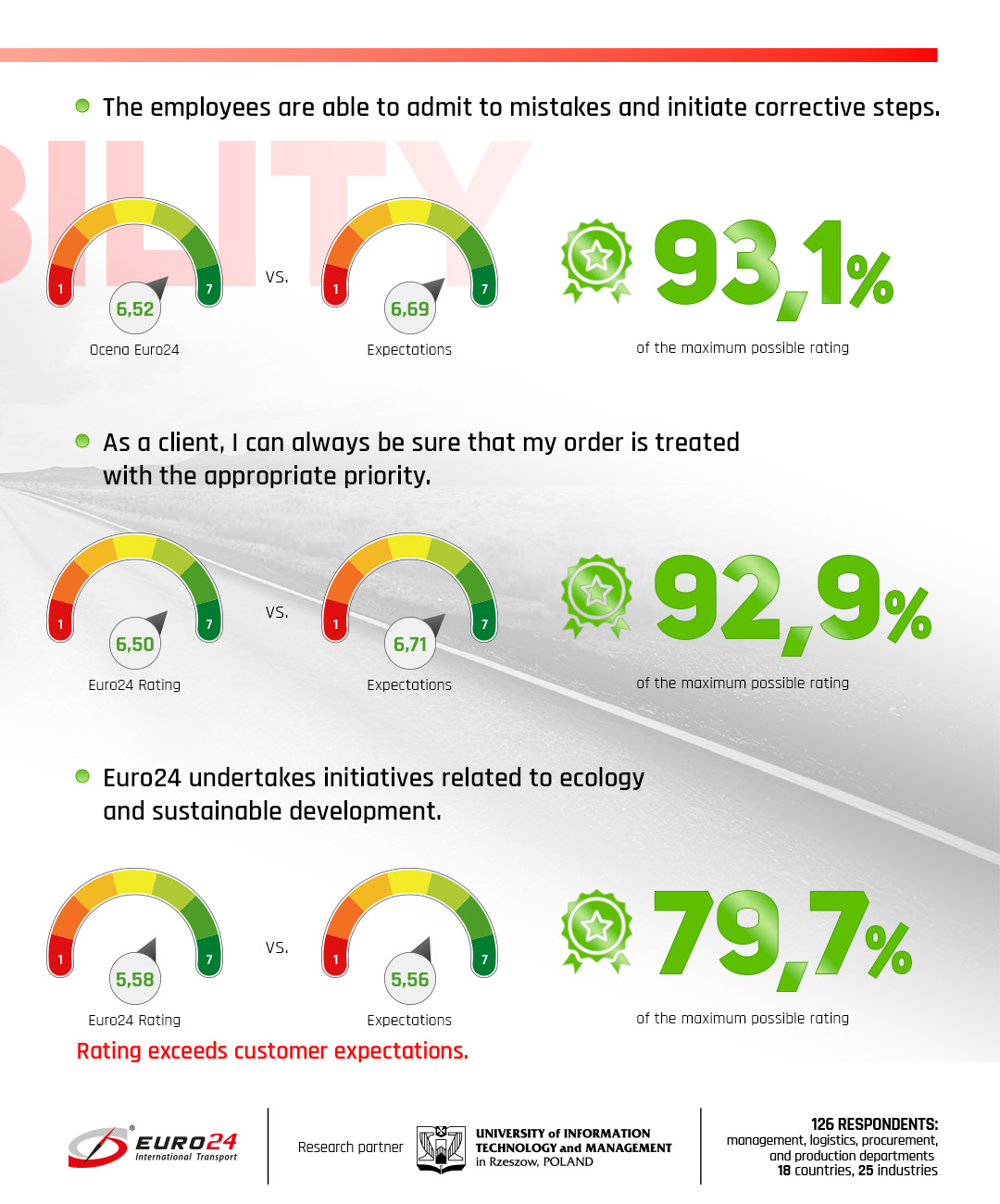
The graphics below present the results of the Euro24 Service Quality Survey from 2024.




From Results to Action: areas covered by the improvement plan
Over the two years between the survey editions, the TSL market has undergone a profound transformation. Cost pressure, a drastic shortage of drivers, and successive regulatory packages have heightened the importance of efficient, error-free service. Widespread digitalization has also played its part – customers have grown accustomed to real-time cargo tracking and instant feedback. Questions about detailed reporting or CO2 emission levels have permanently entered standard RFQs. Today, a quick response and full transparency are the absolute minimum, not a competitive advantage.

These market trends are reflected in Euro24’s results. Our partners expect an even faster first response to inquiries and a maximally clear description of the full scope of services (including monitoring, security, insurance, and the availability of a dedicated team). At Euro24, we openly communicate these challenges and treat them as a natural direction for development.
Although our inquiry handling process is based on close cooperation between the sales representative and the freight forwarder managing the order (which gives the customer a single point of contact and a clear division of responsibility), after the 2026 survey edition, the area of response time was officially included in our internal improvement plan. The effects of these actions and the implemented corrective procedures will be verified by the next edition of the survey, exactly as this year’s results verified the work we did after 2024.
First Evaluation of Euro24 Air Freight
The 2026 edition brought a significant innovation. For the first time, the quality survey covered Euro24’s air freight service. Two years ago, this area was not yet evaluated because the 2024 questionnaire focused exclusively on road transport. Expanding the scope of the analysis reflects our company’s evolution toward multimodal services, and the scale of this development is best illustrated by concrete numbers.
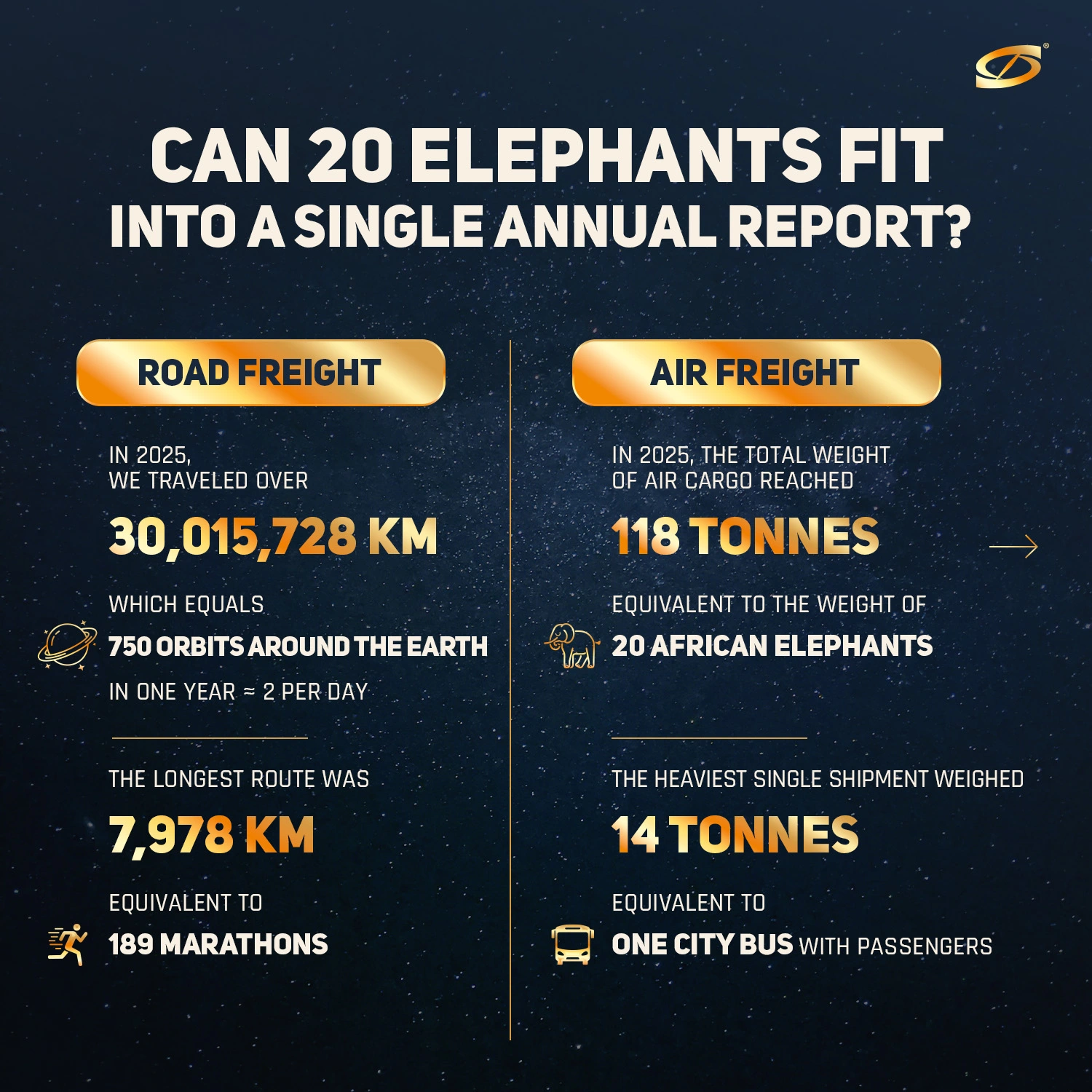
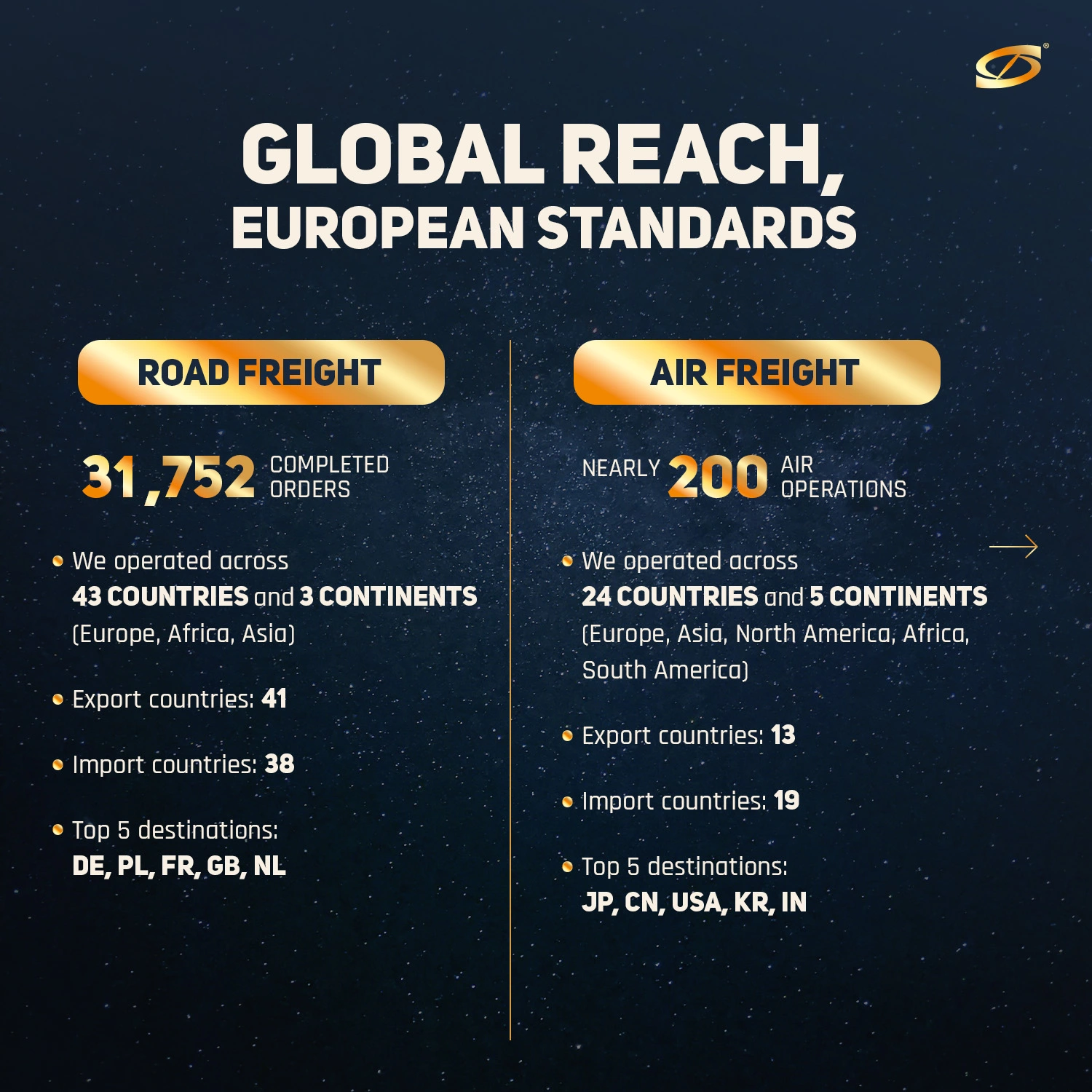
In 2025 alone, Euro24 completed nearly 200 air operations, transporting 118 tonnes of cargo to 24 countries across 5 continents (with the heaviest single shipment weighing as much as 14 tonnes). Our key destinations are Japan, China, the USA, South Korea, and India – markets of strategic importance for the electronics, automotive, and aviation industries. Since Euro24 operates in the very heart of the Aviation Valley in Podkarpacie, handling shipments with AOG (Aircraft on Ground) status is a natural extension of our capabilities.
The average rating for this service was 6.47/7, which represents a 100% match between the actual customer experience and their baseline expectations. What is particularly important, in three out of five surveyed areas, the rating exceeded our partners‘ requirements. This applies precisely to those criteria that are of key importance in air logistics: executing orders in accordance with agreements, ongoing communication regarding shipment status, and quick response in non-standard situations. In high-priority shipments, quality is verified in moments of sudden complications and that is exactly when true customer trust is built.
To ensure full methodological reliability, the survey included only those customers who actually use Euro24’s air freight services (N=11). We treat the gathered results as our first baseline measurement, which we will regularly repeat in subsequent editions as the scale of this business grows. Two criteria – completeness and timeliness of documentation, and response time to RFQs -fell slightly below our partners‘ expectations. Both of these areas have already been analyzed and incorporated into our internal improvement standards so that we can eliminate these minor delays in our daily operations.
In the 2026 edition, Euro24’s air freight was evaluated for the first time using the SERVQUAL formula. The results:
| Air freight evaluation criterion | Customer expectations (average, scale: 1-7) | Euro24 rating (average, scale: 1-7) | Expectation fulfillment |
|---|---|---|---|
| Execution of orders in accordance with agreed terms (time, scope, method) | 6,45 | 6,55 | 101,6% |
| Communication and updates on order status | 6,45 | 6,55 | 101,6% |
| Quick information and proposed actions in non-standard situations | 6,45 | 6,55 | 101,6% |
| Completeness and timeliness of documentation | 6,55 | 6,36 | 97,1% |
| Response time to RFQs | 6,45 | 6,36 | 98,6% |
| Average for the service | 6,47 | 6,47 | 100,0% |
61.6% of respondents use Euro24 Air Freight
The conducted survey revealed yet another extremely strong signal: the trust built on road freight naturally transfers to other services. Currently, 61.6% of respondents use air freight in their own supply chains. When asked whether they would entrust this service to Euro24, customers replied unequivocally, as many as 73.5% of them declare full readiness for such cooperation. This represents nearly three-quarters of the companies, which perfectly know the specifics of the aviation market and have a direct comparison with other global providers.
Our partners show similar openness toward other transport sectors. Sea freight cooperation with Euro24 is declared by 63.9% of companies using this type of freight, while rail cooperation (in the strategic China-Poland corridor) stands at 58.8%. The fact that customers who know our road service want to expand the partnership into new areas, even before they physically use them, is the best confirmation of our brand’s strength and credibility. For manufacturing companies, this also brings a tangible business benefit: the possibility of full service consolidation under a single, proven provider. A perfect example of this is the hybrid model: an urgent shipment flies from Asia to a European hub, and the final leg directly to the manufacturing plant is covered by our road transport.
Euro24 in numbers – operational data and survey results in a nutshell
The development of a transport company does not come from mere declarations, but from the regular and reliable verification of its own processes. This is why, every two years, Euro24 asks customers to evaluate cooperation and confronts these opinions with hard operational data. Dialogue with a partner, including discussions regarding areas that need improvement, is the shortest path to raising service quality. The SERVQUAL method gives these discussions a clear structure and allows us to precisely measure progress from edition to edition. The effects of this consistent approach are best illustrated by the numbers below:
- 31,752 road orders completed in 2025 over a total distance of 30,015,728 km, which is the equivalent of 750 laps around the globe.
- Serving 43 countries across 3 continents in road transport (our TOP 5 destinations are: Germany, Poland, France, Great Britain, and the Netherlands).
- Nearly 200 air operations and 118 tonnes of cargo delivered to 24 countries on 5 continents.
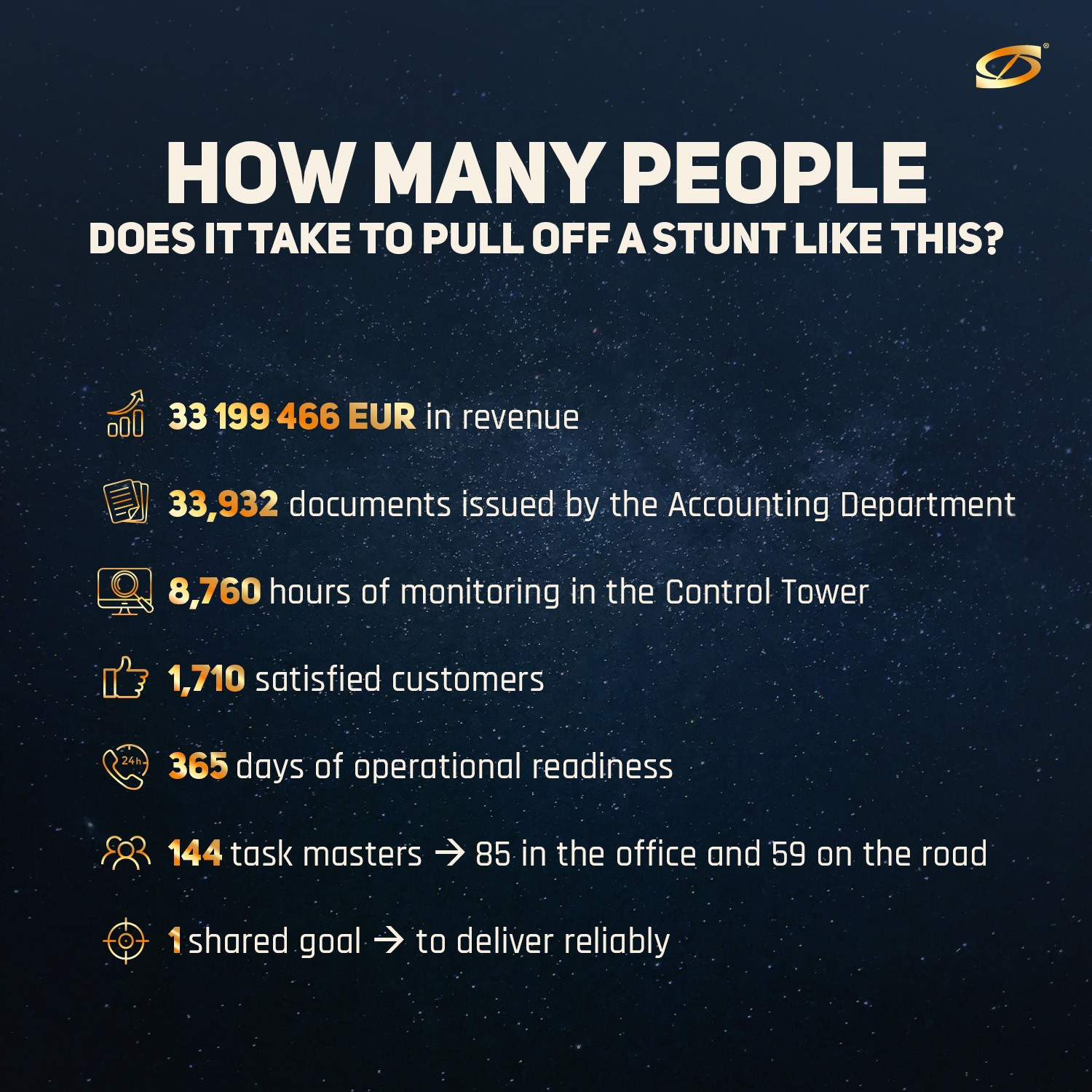
- 8,760 hours of Control Tower operation per year– ensuring round-the-clock shipment monitoring 365 days a year, 24 hours a day.
- Air freight: an average customer rating of 6.47 out of 7 possible, exactly matching average expectations –100% compliance with expectations, including 101.6% in order execution, communication, and handling non-standard situations.
- Expectation fulfillment above 100% in key areas, including: the possibility of evening transport valuation (102.0%), quality certificates (101.2%), service culture (100.9%), and round-the-clock availability (100.9%).



How to Evaluate a Provider’s Transport Service Quality?
Four takeaways for logistics and procurement

Facts instead of promises
Declarations of „reliability“ and a „tailored approach“ can be found in the offer of almost every carrier. Instead of taking their word for it, demand hard operational data. Check key performance indicators (KPIs) for transport carried out in your specific industry. A professional operator manages processes based on hard data and will not hesitate to present you with punctuality reports as well as references from clients with similar operational profiles. If a company cannot back up its effectiveness with concrete numbers, promises of high quality will likely end with the first serious order.
Customer service standards
The second critical area is daily service. Ask about the standard response time to an RFQ and establish exactly how tracking updates are handled. Does the company provide 24/7 monitoring, or do you have to ask for updates yourself? Check the team’s availability outside standard office hours. A production line failure does not wait until Monday and neither should your provider. Request a written, practiced procedure for delays or cargo damage, and ensure their employees can apply it in high-stress situations, as confirmed by high ratings in the problem responsiveness criterion.
Financial stability and insurance
Choosing a cheap but unstable carrier is a direct threat to your business continuity. In the first half of 2025 alone, over 3.7 thousand European transport companies declared insolvency. Before you sign a contract, thoroughly verify your partner’s financial health and the actual scope of their insurance (carrier’s liability insurance for domestic and international transport, including clauses on theft or delays). Check if the carrier holds quality certificates and audits dedicated to your sector. It is always a good idea to start cooperation with a few pilot shipments, this is the quickest test of reliability in practice. (source: PITD report and logistyka.net – who will survive the transport crisis?)
Adapting to regulatory changes
The accumulation of regulations in 2026 will heavily impact vehicle availability and delivery punctuality. The new obligation to install tachographs and restrictive driver working time regulations will cover vans with a GVW of 2.5–3.5 t, which may force some smaller carriers to scale back their international operations. This will temporarily reduce the supply of van-type vehicles on the market. Furthermore, a new kilometer tax in the Netherlands will significantly alter cost calculations for Benelux routes, and tighter ADR regulations require immediate training updates across the entire supply chain. The takeaway for logistics departments is clear: verify right now whether your key providers are ready for these changes. Their operational issues in August may become your production problems in September.
Transport service quality is shifting from a mere marketing slogan into a key criterion for selecting a provider. The Euro24 2026 SERVQUAL survey proves how to fill this criterion with real substance. Customers rated our services at 97.8–102% of their baseline expectations in key service areas. In its debut survey, air freight achieved Transport service quality is shifting from a mere marketing slogan into a key criterion for selecting a provider. The Euro24 2026 SERVQUAL survey, with all statistical analysis and reporting handled independently by the University of Information Technology and Management in Rzeszow (UITM), proves how to fill this criterion with real substance. Customers rated our services at 97.8–102% of their baseline expectations in key service areas. In its debut survey, air freight achieved full compliance with our partners‘ requirements. Meanwhile, the areas identified after the 2024 edition – namely transport security, rapid response to problems, and flexibility – showed real and tangible improvement. And where the bar still sits incredibly high, Euro24 speaks about it openly, immediately setting clear directions for improvement.full compliance with our partners‘ requirements. Meanwhile, the areas identified after the 2024 edition -namely transport security, rapid response to problems, and flexibility -showed real and tangible improvement. And where the bar still sits incredibly high, Euro24 speaks about it openly, immediately setting clear directions for improvement.
In the dynamically changing TSL market, such a transparent approach takes on special significance. New legal regulations, a deepening shortage of drivers, and relentless cost pressures will continue to ruthlessly test the reliability of carriers. The winners will be those who can prove their quality with hard data and who listen to their customers, staying ahead of market standards. Euro24 intends to steadily lead this group. The next edition of the survey will uncompromisingly verify the effectiveness of our actions. And this is indeed the most important declaration of this article: the results we proudly publish today will be measured again in two years and openly shown to you.
FAQ
SERVQUAL is a scientific method for measuring service quality. Customers evaluate the same criteria twice: first, as their expectations of a benchmark provider, and second, as the actual rating of the surveyed company. The result shows to what extent the experience aligns with expectations. 100% means full compliance. A result above 100% means the service was rated higher than the benchmark.
Ask for data, not declarations. Ask for satisfaction survey results along with a description of the methodology. Check response time standards, shipment monitoring methods, and delay response procedures. Verify certificates, experience in your industry, and the company’s stability. In the first half of 2025, over 3.7 thousand European transport companies declared insolvency. Therefore, this criterion is becoming particularly important.
Euro24 has implemented internal SLA standards for the first response time. Every inquiry receives an automated confirmation of receipt. The company also offers evening quoting and transport execution. In the 2026 survey, customers rated this capability at 102% of their expectations. The Control Tower operates 24/7, including weekends and holidays.
In 2025, Euro24 completed nearly 200 air operations to 24 countries across 5 continents. The most important destinations are Japan, China, the USA, South Korea, and India. The company handles urgent production shipments and components for the automotive and aviation industries, including AOG shipments. The heaviest single air cargo load weighed 14 tonnes.
Yes. Euro24 serves clients from the automotive, aviation, chemical, and electronics industries. Rigorous documentation, certification, and time requirements are standard there. In the 2026 survey, the company’s quality certificates were rated at 101.2% of customer expectations.
A result of 100% means that our service fully matched the customer’s idea of an ideal provider. Any result above 100% (such as 102.0% for evening transport quoting) means that in that specific area, Euro24 actually exceeded initial expectations and delivered a standard that goes beyond the market benchmark.
Very directly. The 2024 survey indicated that we needed to work harder on security and emergency procedures. We implemented changes, and the 2026 survey confirmed that these areas have clearly improved (achieving ratings at or above customer expectations). For you, this means one thing: we do not just promise a higher standard, we prove with data that we actually delivered it.
Do you have questions?
Contact us. Together, we will find solutions for your transport needs. Schedule a „virtual coffee“ with our Account Manager and find out how we can provide you with the comfort of cooperation you need.
Find out how we can support your business.