Blog

Trade Fair Transport 2027: How Are Changes in the Exhibition Industry Affecting Logistics?
Published: 2 November 2026
Transport for the exhibition industry changed in 2026 more because of the structure of demand than its scale. There are fewer exhibitors than before the pandemic, but their stands are larger: in Poland, the average exhibitor now occupies 42.7 m² compared with 29.7 m² in 2019, so every order means more cargo within the same rigid build-up window. At the same time, transport is getting more expensive: in Q2 2026, contract road freight rates in Europe were 15.2% higher than a year earlier, and since 1 July, vans from 2.5 to 3.5 t used in international hire-and-reward transport must be fitted with a tachograph.
Find out how trends in the exhibition industry, geopolitics and new regulations translate into cargo volumes, costs and the type of transport services needed. The data comes from reports by UFI (the Global Association of the Exhibition Industry), the German trade fair association AUMA, the Polish Chamber of Exhibition Industry (PIPT), the International Road Transport Union (IRU), the International Air Transport Association (IATA), the European Commission and government authorities. Data as of 29 October 2026. Sections marked as Polish context apply only to companies that ship stands and exhibits from Poland or exhibit at trade fairs in Poland.
Key takeaways:
- Volume in Poland is growing. Rented exhibition space grew by 4.8% in 2025 to 736,010 m², the highest level since 2019 (PIPT). Every additional square metre means more stand components and exhibits to transport.
- Demand in Germany is weakening. In Q1 2026, space rented at German trade fairs fell by 4.6% and the number of exhibitors by 2.3% (AUMA).
- Transport is getting more expensive. The average diesel price in the EU was EUR 1.94 per litre in Q2 2026, 27% more than a year earlier (IRU).
- Journeys are getting longer. A tachograph in vans up to 3.5 t means driving time rules, and in the Polish context there are also checks at the border with Germany, which will remain in place until at least 30 March 2027.
- Air freight to trade fairs outside Europe is under pressure. Jet fuel was 79.2% more expensive in August 2026 than a year earlier, and cargo traffic between Europe and the Middle East fell by 12.1% (IATA).
- Services matter more, not just transport. Exhibitors need express delivery within hours, 24/7 monitoring, return logistics and digital documents such as the ATA Carnet.
The exhibition industry in numbers: what each figure means for transport
For a logistics provider, the most important indicator in the exhibition industry is rented space, because it translates into the number of stand components, exhibits and equipment to be transported. The number of exhibitors, in turn, shows how many separate orders there will be.

| Indicator | Value | What does it mean for transport? | Source |
|---|---|---|---|
| Exhibitions worldwide | 32,000 (2024/2025) | Steady, dispersed demand for transport with clear peaks in the trade fair season | UFI GEIS, April 2026 |
| Rented space worldwide | 138 million m² vs 143.7 million m² in 2019 | The global volume of stand construction has still not returned to pre-pandemic levels; growth has to be found in specific countries | UFI GEIS |
| Trade fairs in Europe | 1.29 million exhibitors, 43.2 million m², 520 exhibition centres | The largest network of venues in the world, and therefore the most road transport over short and medium distances | UFI and Oxford Economics |
| Road freight rates in Europe, Q2 2026 | contract rates up 15.2%, spot rates up 13.9% year on year | The budget for stand transport needs to be planned higher than in 2025 | IRU, 11 August 2026 |
| Truck driver shortage in Europe | 13%, i.e. approx. 502,000 unfilled positions | Harder to find an available vehicle at the peak of the trade fair season | IRU, 30 June 2026 |
Key trade fair markets in Europe and Poland
| Country | Trade fair market: latest data | Trend in 2026 | What it means for transport from Poland |
|---|---|---|---|
| Germany | 2025: over 300 trade fairs, approx. 192,000 exhibitors, over 12.7 million visitors (AUMA) | In Q1 2026, 2.3% fewer exhibitors and 4.6% less rented space than a year earlier. Around 40% of organisers view the situation pessimistically and around 20% optimistically (AUMA) | The most important destination for Polish exhibitors, but fewer stand loads and shorter build-up windows |
| Italy | 2025: 915 events, 152,000 exhibitors, 18.5 million visitors and almost 11 million m² of space sold, the most in history (AEFI and Prometeia, via Milano Finanza) | In the June AEFI survey, 46% of organisers expected higher revenue in H1 2026 than a year earlier, and 49% expected fewer foreign exhibitors (AEFI, via Il Sole 24 Ore) | Long routes to Milan, Verona or Bologna. With a tachograph in the van, a double crew or an overnight stop is needed |
| Spain | 2025: 472 trade fairs, 64,236 exhibitors (up 6.9%), 4.07 million m² (up 2%), 6.8 million visitors (up 9.8%) (AFE) | AFE expects a very good 2026. In the July UFI survey, more than 4 in 10 Spanish trade fair companies expected rented space to grow by more than 5% (UFI) | A growing destination, but the most distant by road in the EU. The route must be planned around driving time rules with a margin for build-up |
| France | 2025: according to UNIMEV, all indicators grew, i.e. the number of exhibitors, visitors and rented space, most strongly at international trade fairs (UNIMEV) | In H1 2026, rented stand space at trade shows in the Paris region rose by 9.5% and the number of exhibitors by 10% compared with the previous edition (CCI Paris Île-de-France) | Full truckload (FTL) or groupage (LTL) road transport |
| United Kingdom | 2025: approx. 1,154 exhibitions and 6.8 million visits, the most since 2015 (Events Industry Alliance) | In the July UFI survey, 54% of UK trade fair companies expected revenue growth of more than 5% in 2026, compared with 24% in Germany (UFI) | Every shipment requires customs clearance, an ATA Carnet and an electronic travel authorisation (ETA) for the driver |
| Poland | 2025: 119 trade fairs, 736,010 m² (up 4.8%), 17,218 exhibitors (down 3.2%), of which 25.2% from abroad (PIPT) | Record-breaking MSPO 2026: 1,209 exhibitors from 43 countries (Expo Kielce). Defence spending is driving industrial trade fairs | Fewer orders but larger loads: 42.7 m² per exhibitor vs 29.7 m² in 2019 |
Trade fair transport volumes: where is demand growing and where is it falling?
In 2026, demand for trade fair transport in Europe is stable overall, but it is shifting between countries. The best measure is rented space, which is surveyed every six months by the UFI Global Exhibition Barometer. The 37th edition, published on 8 July 2026, received responses from 466 companies in 59 countries.

In the June 2026 survey, 26% of trade fair companies expected to rent more than 5% more space to exhibitors in 2026 as a whole than in 2025. 38% expected stability, and 21% a decline of more than 5%.
Six months earlier, 44% of companies expected growth and only 8% a decline
In June, the industry’s biggest concerns were the domestic economy (19%), geopolitics (18%) and the global economy (16%). In Europe, geopolitics ranked first at 22%
For logistics, this means a year without a boom, but with greater volatility. Where organisers are losing exhibitors, the number of large stand loads is shrinking. Where they are gaining exhibitors, those exhibitors look for carriers at the last minute.

Germany: fewer loads on the most important route
For Polish exhibitors and stand builders, Germany is the number one market. In 2025, it hosted over 300 trade fairs with around 192,000 exhibitors. According to AUMA, however, in Q1 2026 the number of exhibitors fell by 2.3% and rented space by 4.6%.
AUMA highlights two developments that matter for carriers. Some organisers are shortening the duration of trade fairs and compensating with more services, which means shorter build-up and dismantling windows. In addition, according to the AUMA Messe-Politikbrief of 28 October 2026, the budget for Germany’s programme of national pavilions abroad is set to fall from EUR 44 million in 2026 to EUR 41.4 million in 2027, and the number of planned joint stands is falling from 263 in 2025 to 237 in 2026 and provisionally 217 in 2027. Over 90% of German organisers consider rising costs a serious challenge, and pessimists (around 40%) outnumber optimists (around 20%) two to one.
Road freight data sends an interesting signal. According to IRU, traffic on the Germany–Poland corridor grew by 1.5% year on year in Q2 2026, making it the only major corridor in Europe to grow. During the trade fair season, stand transport therefore competes for vehicles with growing freight traffic.
Persian Gulf: cancelled and postponed events
The conflict with Iran, which began at the end of February 2026, hit trade fairs in the Gulf the hardest. According to UFI, 55% of companies from the Gulf Cooperation Council (GCC) countries report a strong negative impact. In Europe, the most common effects were lower exhibitor participation in already confirmed events (74% of responses) and postponed dates (33%). For a carrier, this means cancelled orders, rebookings and loads waiting in a warehouse for a new date.
Where is demand for transport growing?
- Spain and Turkey: in the July UFI survey, more than 4 in 10 trade fair companies expected rented space to grow by more than 5%.
- United Kingdom: 54% of trade fair companies expected revenue growth of more than 5%. Every shipment there requires customs clearance.
- USA: CEIR, the Center for Exhibition Industry Research, forecast in May 2026 that the B2B exhibition market would grow by 2.1% over the full year.
- Poland: rented space grew by 4.8% in 2025; more on this in the next section.
Trade fair market by region
Poland: fewer exhibitors, larger stands, bigger loads
The Polish trade fair market is growing where it matters for logistics, i.e. in square metres. According to the PIPT EXPO 2025 report, published in September 2026, exhibitors rented 736,010 m² in 2025, 4.8% more than a year earlier. The report covers 119 trade fairs in 12 cities, audited by CENTREX PIPT auditors.
| Indicator | 2019 | 2024 | 2025 | Change 2025 vs 2024 | 2025 as % of 2019 |
|---|---|---|---|---|---|
| Number of trade fairs | 189 | 129 | 119 | down 7.8% | 63% |
| Net space (m²) | 760,932 | 702,222 | 736,010 | up 4.8% | 97% |
| Exhibitors | 25,598 | 17,786 | 17,218 | down 3.2% | 67% |
| Foreign exhibitors | 5,339 | 4,244 | 4,338 | up 2.2% | 81% |
| Visitors | 1,580,846 | 1,387,749 | 1,360,434 | down 2.0% | 86% |
| Space per exhibitor (m²) | 29.7 | 39.5 | 42.7 | up 8.3% | 144% |
Source: PIPT EXPO 2025. Percentage changes and space per exhibitor calculated on the basis of the report’s tables.
What does this mean for transport?
- Fewer orders, bigger loads. Space has returned to 97% of the 2019 level, but the number of exhibitors only to 67%. The average exhibitor now occupies around 44% more square metres than before the pandemic. Part of this difference is due to the smaller number of audited events, but the direction is clear: stand construction no longer fits in a van and increasingly travels by rigid truck or semi-trailer.
- More inbound traffic. The share of foreign exhibitors rose from 20.9% in 2019 to 25.2% in 2025. This means shipments into Poland and, for companies from outside the EU, temporary admission of exhibits.
- Demand concentrated in a few cities. Most trade fairs took place in Poznań (52) and Kielce (27). During the build-up days of the largest events, expect queues for unloading and a shortage of accommodation for drivers and fitters: during the MEBLE POLSKA fair, hotel occupancy in Poznań reached 99.1% according to PIPT.
- Heavy exhibits. The industry and machinery sector accounts for 14 events and 2,229 exhibitors, and agriculture for 7 events and 288,556 visitors. These are loads that require a suitable vehicle and unloading by forklift or crane.
Defence: a new, heavy segment of trade fair transport
The strongest boost for Polish trade fairs comes from the defence industry. According to the Chancellery of the Prime Minister, defence and security spending in 2026 is expected to reach PLN 200 billion, or 4.81% of GDP.
The International Defence Industry Exhibition (MSPO) in Kielce (8–11 September 2026) attracted, according to the organiser, 1,209 exhibitors from 43 countries and 45,000 visitors. All the space was sold out even before the opening (Defence24). The exhibition used a new hall for the first time, and on 8 September 2026 Targi Kielce rebranded as Expo Kielce. For logistics, these are heavy, often high-value loads that require proper securing, insurance and constant monitoring.
Costs in Poland and major events ahead
In May 2026, the European Commission forecast that Poland’s GDP would grow by 3.5% this year, against an EU average of 1.1%, with inflation at 3.6%. The minimum wage rose to PLN 4,806 gross, which increases the cost of build-up, loading and technical support.
Events on the horizon will generate large loads. From 27 September to 1 October 2027, Poznań will host the 78th International Astronautical Congress. PIPT expects over 10,000 participants from more than 120 countries and over 500 exhibitors.
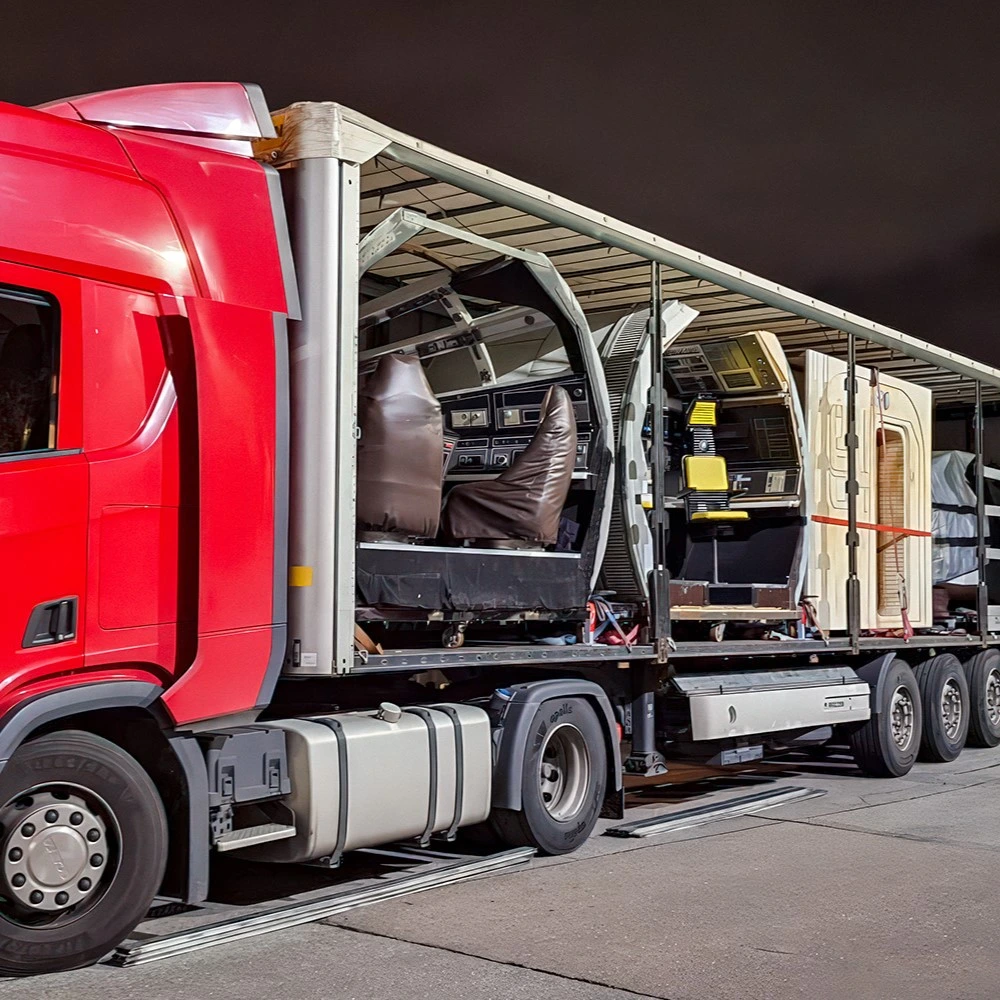
Trade fair transport costs in 2026: fuel, drivers, regulations
Transporting a stand costs significantly more in 2026 than a year earlier, and the reason is costs, not demand. IRU states plainly that in Q2 2026 carriers were unable to absorb the rise in diesel prices and passed it on to customers.
| Cost factor | Data | Impact on trade fair transport |
|---|---|---|
| Diesel | An average of EUR 1.94 per litre in the EU in Q2 2026, 27% more than a year earlier. Peak in April: EUR 2.19. On 22 July, the price exceeded EUR 2 again (IRU) | Higher fuel surcharges, especially on long routes to Germany, France, Italy and Spain |
| Fuel prices in autumn 2026 | In September 2026, diesel rose by 5.9% in the EU and by 9.7% in Poland compared with August. Fuels and lubricants for passenger vehicles were 31.4% more expensive in the EU than a year earlier (Eurostat, 21 October 2026) | Pressure on rates continues in the autumn trade fair season, and runs for spring 2027 are hard to price without a fuel clause |
| Polish context: fuel tax cut | From March 2026, VAT on fuel was cut from 23% to 8% and excise duty to the EU minimum. The lower VAT rate applied until 30 June 2026 (Ministry of Finance) | Since July, refuelling in Poland no longer cushions the rise in oil prices |
| Road freight rates | Contract rates up 15.2%, spot rates up 13.9% year on year. Carriers’ operating costs rose by almost 10% | One-off trade fair orders, priced at spot rates, are becoming more expensive the fastest |
| Drivers | A 13% shortage, around 502,000 unfilled positions in Europe. By 2030, around 660,500 drivers will retire (IRU) | Lower vehicle availability at the peak of the trade fair season; book in advance |
| Tachographs in vans up to 3.5 t | Since 1 July 2026, the same driving time rules as for trucks apply in international hire-and-reward transport (GITD) | Express van runs to distant trade fairs require a double crew or an overnight stop, so they cost more |
| Air freight | Jet fuel in August 2026 was 79.2% more expensive year on year. Europe–Middle East cargo traffic down 12.1% (IATA) | Higher rates and fewer connections via the Gulf for transport to trade fairs in Asia and the Middle East |
| Polish context: border checks | At the borders with Germany and Lithuania until at least 30 March 2027 (MSWiA) | A time buffer for deliveries to fixed build-up windows |
| Polish context: labour costs | Minimum wage PLN 4,806 gross, up 3% | More expensive loading, build-up and warehouse handling |
| ETS2 from 2028 | According to the EC’s assessment, around EUR 0.13 more per litre of diesel at a price of EUR 48 per tonne of CO2 (EPRS) | A permanent, systemic increase in fuel costs in multi-year contracts |
How to reduce the cost of stand transport?
- Match the vehicle to the square metres, not to habit. For a stand larger than a few dozen square metres, one larger vehicle can be cheaper than two vans and requires one unloading slot instead of two.
- Book earlier. With the driver shortage and spot rates 13.9% higher year on year, an order placed a week before build-up usually costs more than one planned well in advance.
- Consolidate. Materials from several exhibitors going to the same trade fair can travel as groupage (LTL, meaning you pay only for the part of the vehicle you use).
- Include a fuel clause. With diesel prices ranging from EUR 1.76 to EUR 2.19 per litre within a single quarter, a fair fuel adjustment protects both parties.
- Plan the route around driving time rules. Where a van is subject to the tachograph requirement, journey time is calculated according to the regulations, not according to the map.
Geopolitics from the perspective of routes, dates and trade fair loads
In 2026, geopolitics is the exhibition industry’s second biggest concern worldwide and the first in Europe. For logistics, it translates into three things: longer or more expensive routes, uncertain dates and additional formalities at borders.
The conflict with Iran: air routes and the Strait of Hormuz
The conflict began on 28 February 2026 with US and Israeli strikes on Iran. The ceasefire of 8 April was extended in June by 60 days, but according to the European Union Aviation Safety Agency (EASA), its implementation remains fragile. EASA recommends not flying over Iran at any altitude. A second EASA bulletin recommends avoiding the airspace over the waters of the Persian Gulf in the area of Bahrain, Kuwait, Qatar and the United Arab Emirates, except for take-offs and landings at airports there. Both bulletins are valid until at least 16 November 2026.
The European Commission calculated that the de facto closure of the Strait of Hormuz reduced seaborne oil supplies by around 15% and LNG supplies by around 20%. Between 27 February and 29 April 2026, oil prices rose by around 65% and gas prices by around 50%. This is the direct cause of more expensive fuel in road and air transport.
At the end of October 2026, the situation remains unresolved. In its conclusions of 16 October 2026, the European Council condemned all actions that prevent merchant vessels from entering and leaving the Strait of Hormuz and called for a coordinated European response to high energy prices.
For trade fair transport, this means two changes. Air freight to events in Asia and the Persian Gulf is more expensive and less predictable, as some connections bypass the region. Loads for trade fairs in the Gulf may also get stuck in a warehouse if the organiser postpones the event, which according to UFI affected one in three trade fair companies in Europe.
The war in Ukraine: borders and new demand
The war continues without a ceasefire. In its conclusions of 16 October 2026, the European Council once again called on Russia to agree to a full, unconditional and immediate ceasefire.
For trade fair logistics, there are two consequences. First, in the Polish context, the government is maintaining checks at the borders with Germany and Lithuania, extended until 30 March 2027 due to migration pressure instigated by Belarus. Second, record defence spending is driving defence and industrial trade fairs, and with them demand for the transport of heavy, high-value exhibits.
US tariffs: relevant when an exhibit stays across the ocean
On 20 February 2026, the US Supreme Court ruled that the International Emergency Economic Powers Act (IEEPA) does not give the president the power to impose tariffs. Since 24 July 2026, goods from the EU have been subject to a Section 301 tariff of 10% inclusive of the most-favoured-nation (MFN) rate, as confirmed by a notice from the US Trade Representative.
The tariff matters mainly when an exhibit stays in the USA because it was sold at the trade fair. Equipment that returns to Poland should travel under temporary admission, not as a regular import.
Formalities for drivers and teams
- United Kingdom: since 2 April 2025, EU citizens need an electronic travel authorisation (ETA). It currently costs GBP 20, and since 25 February 2026 airlines may refuse boarding to anyone without an ETA. The authorisation must also be arranged for drivers.
- Schengen area: since 10 April 2026, the EES system has been operating at all external borders, recording the fingerprints and facial images of non-EU nationals. This also applies to drivers with such citizenship when travelling to trade fairs in the UK or Switzerland.
- USA: since 1 January 2026, the fee for the ESTA electronic travel authorisation has been USD 40.27.
Map of geopolitical risks in trade fair transport
| Risk | What is happening | Impact on transport | What to do |
|---|---|---|---|
| Conflict with Iran | Fragile ceasefire; EASA recommends avoiding the airspace over Iran and over the waters of the Persian Gulf; disruption in the Strait of Hormuz continues | More expensive and less predictable air freight to Asia and the Gulf, postponed trade fairs in the region | Book freight with time to spare and have a plan B for the route |
| Fuel prices | Diesel in the EU on average 27% more expensive year on year in Q2 2026 | Higher road rates and fuel surcharges | Fuel clause, load consolidation |
| War in Ukraine | No ceasefire. Polish context: checks at the borders with Germany and Lithuania until 30 March 2027 | Longer journeys, more transport to defence trade fairs | Time buffer and real-time journey monitoring |
| US trade policy | Section 301 tariff for the EU: 10% including MFN | Costs rise only for exhibits sold in the USA | Clear returning exhibits under temporary admission |
| Travel formalities | ETA in the UK, ESTA in the USA, EES in Schengen | Longer preparation for drivers and teams | Submit applications a few weeks before departure |
Regulations changing trade fair transport in 2025–2028
Road, customs and border regulations bring the most changes for the transport of stands and exhibits. The table lists them, starting with the most urgent.
| Regulation | Effective from | Who it applies to | Impact on trade fair transport |
|---|---|---|---|
| Tachographs in light vehicles (Mobility Package) | 1 July 2026 | Vehicles with a gross vehicle weight (GVW) over 2.5 t up to 3.5 t in international hire-and-reward transport and cabotage | Second-generation smart tachograph (G2V2), driver card, driving and rest time rules. Longer journey time or a double crew |
| Digital ATA Carnet | 1 June 2026 in the EU, Norway, Switzerland and the UK; full transition by the end of 2027 | Exhibits and equipment temporarily exported outside the EU customs territory | Less paperwork and faster clearance on the way to trade fairs in the UK, Switzerland and Norway |
| Polish context: checks at the borders with Germany and Lithuania | extended from 2 October 2026 to 30 March 2027 | Passenger and freight traffic across internal borders | A time buffer for deliveries to trade fairs in Germany and the Baltic states |
| EES system | launched 12 October 2025, fully operational since 10 April 2026 | Non-EU nationals on short stays, including drivers | A longer first check at the Schengen external border |
| UK ETA | 2 April 2025, currently GBP 20 | EU citizens, including drivers and fitters | No ETA means no entry and no boarding |
| ETIAS | not yet operational; the EU will announce the date several months in advance | Visa-exempt travellers from outside the EU | A EUR 20 fee for non-EU exhibitors and fitters coming to trade fairs in Poland |
| New A1 certificate rules | adopted by the EU Council on 28 September 2026, applicable 24 months after the changes enter into force | Employees travelling on business to another EU country | A sales team travelling to a trade fair will not need an A1 certificate. The exemption does not cover the provision of services or the delivery of goods, so drivers and fitters will still need an A1. Until the new rules apply, the current ones remain in force |
| Packaging and Packaging Waste Regulation (PPWR) | 12 August 2026, labelling from 2028, reuse targets from 2030 | Packaging, including transport packaging | More reusable crates, pallets and packaging, and therefore more return logistics |
| ETS2, the emissions trading system for fuels | auctions from 2027, launch in 2028 | Fuels in road transport and buildings | A permanent emissions cost built into the price of diesel |
| CSRD after the Omnibus I package | approved by the Council on 24 February 2026 | Companies with more than 1,000 employees and over EUR 450 million in turnover | The largest exhibitors still need emissions data for their trade fair transport |
Tachographs in vans up to 3.5 t: a change that also affects the exhibition industry
Since 1 July 2026, every vehicle with a GVW over 2.5 t up to 3.5 t carrying goods abroad for hire or reward must be fitted with a type-approved G2V2 digital tachograph. The driver is subject to the same rules as a truck driver: up to 9 hours of driving per day, a 45-minute break after 4.5 hours and 11 hours of daily rest. The regulation also covers vehicles that are already registered.
This is a major change for the exhibition industry, because until now the van has been the main tool for fast deliveries to build-up. A route from Rzeszów, Kraków or Katowice to Hanover or Düsseldorf is no longer one continuous drive by a single driver. Express runs have to be planned with breaks or with two drivers, which changes both the arrival time at the hall and the price of the run.
Poland’s Road Transport Inspectorate (GITD) points to the exemption in Article 3 of Regulation 561/2006: the rules do not cover non-commercial carriage for a company’s own needs, provided that driving is not the driver’s main activity. An exhibitor transporting its own stand in its own van may therefore be exempt. A carrier hired to transport a stand is always subject to the new requirements, and a stand-building company should confirm the nature of its transport with the road transport inspectorate.

The digital ATA Carnet
The ATA Carnet is an international customs document that allows exhibits, professional equipment and display materials to be temporarily imported free of duties and taxes, provided they are re-exported. According to the ICC, it is accepted by around 80 countries and customs territories, and temporary admission can last up to one year. In Poland, carnets are issued by the Polish Chamber of Commerce (KIG).
Since 1 June 2026, the European Union, Norway, Switzerland and the United Kingdom have been the first to accept digital carnets. According to the World Customs Organization, all customs administrations are to switch to the digital system by the end of 2027. A carnet is not needed for trade fairs within the EU.
How are transport services for the exhibition industry changing?
In 2026, trade fair transport orders are moving in two directions. On the one hand, individual stand loads are getting bigger and travel by rigid truck or semi-trailer. On the other, small, urgent runs within hours are becoming more important when something is missing at build-up. In between, new needs are emerging: return logistics, storage between trade fairs, digital documents and emissions data
| Trend in the exhibition industry | What is changing in transport orders | Which service meets the need |
|---|---|---|
| Fewer exhibitors, larger stands (42.7 m² per exhibitor in Poland) | Fewer orders, bigger loads per order | Full truckload (FTL) transport: rigid trucks, standard and mega trailers |
| Shorter trade fairs and fixed unloading slots | Less time for build-up and dismantling | Delivery at a specific time, overnight runs, live monitoring |
| Date volatility (33% of companies in Europe report postponements) | Cancellations, rebookings, address changes | Flexible booking and fast quotes, also outside business hours |
| Missing components at build-up | Urgent runs a few hours before the hall opens | Ad hoc express by van or rigid truck, a dedicated vehicle with no co-loading |
| Higher fuel prices and rates | Pressure on the transport budget | Groupage (LTL), consolidation of several exhibitors, vehicle matched to the square metres |
| Reusable stands and PPWR targets | The stand returns to the warehouse or goes on to the next trade fair | Return logistics, storage between events, fair-to-fair transport |
| Emissions reporting (Net Zero Carbon Events, CSRD) | Questions about the carbon footprint of transport | Emissions data for every order, rail and sea for heavy loads |
| Digitalisation of formalities (ATA Carnet, EES) | Electronic documents instead of paper | A freight forwarder who prepares the customs documentation |
| Boom in defence and industrial trade fairs | Heavy, high-value and sensitive exhibits | Specialist transport, additional cargo insurance, constant monitoring |
| Growth of trade fairs outside Europe (USA, Asia) | Exhibits fly or sail to another continent | Air, sea and rail freight with a single coordinator |
Sustainable trade fairs mean more return logistics
The Net Zero Carbon Events initiative, which has over 500 signatories including the Polish Chamber of Exhibition Industry, aims to cut emissions by 50% by 2030. However, the first reporting round showed that only 47% of reporting organisations measure Scope 3 emissions, which include freight transport and travel.
For transport, this is a twofold change. Modular stands and reusable packaging mean that a stand no longer ends its life in a waste container, but returns to the warehouse or goes straight on to the next trade fair. Organisers and the largest exhibitors also increasingly need emissions data for every shipment to report on their commitments.
The industry itself supports this direction. On 22 September 2026, the Better Stands initiative, which promotes reusable stands instead of single-use builds, received the UFI Sustainable Development Award in the category for the best initiative to reduce emissions. In practice, every reusable stand means additional return transport, storage and another shipment to the next trade fair.
Shipment visibility is becoming the standard
The exhibition industry is digitalising rapidly: according to UFI, 91% of trade fair companies already use AI tools, and 62% are testing or implementing them to streamline processes. An exhibitor who works with such tools every day expects the same from a carrier: real-time shipment status and information about delays before they have to ask. In trade fair transport, where a delay of a few hours means an empty stand on opening day, 24/7 monitoring is no longer an extra.
Trade fair destinations: which transport and which formalities?
Trade fair transport differs from a regular delivery in four ways: a fixed unloading window, mixed cargo (stand construction, exhibits, multimedia equipment, printed materials), return logistics immediately after the trade fair closes, and no second chance, as trade fairs usually last only two to five days.
| Trade fair destination | Most common transport | Formalities in 2026 | What to watch out for |
|---|---|---|---|
| Germany (incl. Hanover, Düsseldorf, Cologne, Munich, Berlin) | road: van up to 3.5 t, rigid truck, semi-trailer | no customs clearance; tachograph in vans over 2.5 t for hire-and-reward transport | Polish context: border checks until 30 March 2027, growing traffic on the Poland–Germany corridor |
| France, Italy, Spain, Benelux | road full truckload (FTL) or groupage (LTL) | as for Germany | long routes require a double crew or an overnight stop for the driver |
| United Kingdom | road with customs clearance | ATA Carnet (digital since 1 June 2026) or temporary admission, ETA for the driver and team | complete documents before departure, clearance time at the port |
| Switzerland and Norway | road with customs clearance | ATA Carnet, digital since 1 June 2026 | list of exhibits with serial numbers and values |
| USA and Asia | air; sea for heavy exhibits; rail also available from China | temporary admission in the trade fair country, ESTA for the team in the USA | more expensive jet fuel, routes avoiding Iran, a larger time margin |
| Middle East | air or sea | check current event dates; some events have been postponed | Europe–Middle East cargo traffic down 12.1%, disruption in the Strait of Hormuz |
Public support rarely covers logistics. At the national stand of the Polish Investment and Trade Agency (PAIH) at InnoTrans 2026 in Berlin, companies used the space free of charge, but paid for transport, insurance of people and goods, accommodation and tickets themselves. Transport therefore has to be planned and paid for regardless of whether a company exhibits on its own or in a national pavilion.
Exhibitor logistics checklist for 2027
- Check the venue’s technical regulations: build-up and dismantling dates, entry slots and whether the trade fair has an official freight forwarder.
- Calculate the floor area and volume of the stand before choosing a vehicle. With today’s stands, a van is often not enough.
- Check whether the transport is for hire or reward. For a van with a GVW over 2.5 t in international transport, a G2V2 tachograph and a driver with a driver card are required.
- Calculate journey time based on driving and rest time rules, not just the map.
- Polish context: allow a buffer for checks at the borders with Germany and Lithuania, which remain in place until at least 30 March 2027.
- For trade fairs outside the EU, prepare an ATA Carnet or temporary admission and a list of exhibits with their values.
- Arrange travel formalities for people: an ETA for the UK for drivers and the team, ESTA for the USA.
- Insure the cargo, especially high-value exhibits and multimedia equipment.
- Prepare a plan B: who will deliver a missing stand component, and within how many hours.
- Plan return logistics: the pick-up time after dismantling, a warehouse or transport to the next trade fair.
- Include a fuel clause in the contract and agree how waiting time at the hall will be charged.
- Ask for transport emissions data if the organiser or your customer requires it.
How does Euro24 handle trade fair transport?
Euro24 is a logistics operator in business since 2007 that transports stand construction, exhibits and event equipment by road and air, and since April 2026 also by sea and rail. In 2025, the company completed 31,752 road orders in 43 countries. 57% of them were carried out by vans up to 3.5 t, 32% by standard and mega trailers and 10% by rigid trucks, so matching the vehicle to the size of the stand is everyday practice, not the exception.
| Exhibitor need | How Euro24 handles it |
|---|---|
| Large stand construction delivered at a specific time | Full truckload transport by van, rigid truck or standard or mega trailer. On-time performance is a measurable KPI against which forwarders are assessed |
| Missing component at build-up | Ad hoc express with a quote in 15 to 30 minutes, also in the evening, at weekends and on public holidays |
| Control over the shipment the night before the hall opens | The Control Tower works in three shifts, 8,760 hours a year, and stays in constant contact with the driver |
| Trade fairs in Germany | A branch in Hanover, next to one of Europe’s largest exhibition centres |
| Trade fairs in the United Kingdom | Customs clearance on EU–UK routes since day one of Brexit, and a branch in London |
| Trade fairs in Asia and the USA | Air freight as an agent of the EAN and PROLOG networks, and since April 2026 also sea and rail freight |
| One point of contact throughout the project | A dedicated account manager and an assigned forwarder who knows the trade fair schedule |
In Poland, Euro24 has branches in Rzeszów, Katowice, Wrocław, Warsaw and Kraków, close to the main production centres from which exhibitors set off, and on the routes to Poznań and Kielce.
Exhibition industry logistics calendar for 2026 and 2027
The coming months will be shaped by regulatory deadlines, political decisions and major events that will generate loads in the region.
| Date | What is happening | Significance for trade fair transport |
|---|---|---|
| 10 November 2026 | IRU will present road freight rates for Q3 2026 | The first hard data on transport costs in the autumn trade fair season |
| 16 November 2026 | The current validity of the EASA bulletins for the airspace of Iran and of the Persian Gulf and Gulf of Oman expires | The decision on an extension will determine air freight routes and prices to Asia and the Middle East |
| 2027 | First allowance auctions under ETS2 | The market will start pricing in the future cost of emissions from diesel |
| 2027 | Germany’s programme of national pavilions abroad: draft budget of EUR 41.4 million and provisionally 217 joint stands vs 263 in 2025 | Fewer consolidated loads for German pavilions abroad |
| 30 March 2027 | Polish context: the current extension of checks at Poland’s borders with Germany and Lithuania ends | A further extension is possible; it is worth following MSWiA announcements |
| 15 May to 15 August 2027 | Expo 2027 in Belgrade: over 130 countries, over 4 million visitors | High demand for exhibition transport on routes through Central Europe to the Balkans |
| 27 September to 1 October 2027 | 78th International Astronautical Congress in Poznań | Over 500 exhibitors according to PIPT, loads from all over the world |
| end of 2027 | All customs administrations are to switch to digital ATA Carnets | The end of paper carnets in trade fair customs clearance |
| 2028 | Launch of ETS2 and harmonised packaging labelling under the PPWR | Higher fuel costs and new labels on transport packaging |
| around the end of 2028 | The new A1 certificate rules start to apply (24 months after the changes enter into force) | Sales teams at trade fairs without A1, drivers and fitters still with A1 |
| 2030 | PPWR packaging reuse targets | More reusable crates and pallets, more return logistics |
| date unknown | Launch of the ETIAS system. At the end of October 2026, the EU had still not announced a date | A EUR 20 fee for non-EU exhibitors and fitters; the EU will announce the date several months in advance |
Summary: fewer orders, bigger loads, higher requirements
The exhibition industry is entering 2027 without a boom, but with a clear structural change. There are fewer exhibitors than before the pandemic, but their stands are larger, so trade fair transport today means fewer orders but heavier and more complex loads. In Poland, volume is growing along with space; in Germany it is temporarily falling; and in the Persian Gulf it depends on how the conflict develops.
Transport costs are rising faster than demand: fuel, road rates, tachographs in vans, the driver shortage and more expensive air freight. Expectations of carriers are rising too. Today, an exhibitor needs not just a vehicle, but delivery at a specific time, 24/7 monitoring, customs handling, return logistics and emissions data.
Planning trade fair transport for 2027? Send us an enquiry for transporting your stand, exhibits or event equipment. You will receive a quote within 15 to 30 minutes, also in the evening and at weekends, and the Euro24 Control Tower will monitor the transport around the clock until the hall opens.
Facing these problems?
- A carrier unfamiliar with the specifics of the exhibition industry
- Difficulties in handling sensitive and non-standard exhibition components
- No up-to-date information on delivery status before build-up and during the event
Facing these problems? Write to us!


Your Logistics Partner
In the exhibition industry, where every hour affects the final result of the display and the schedule leaves no room for delays, punctuality, full readiness of materials and logistics tailored to the rhythm of the event are a necessity. Here, even a slight delay can mean halted build-up, postponed technical inspections and stress for the entire team responsible for the stand and the brand it represents.
We transport stand components, stand structures, sensitive exhibits, prototypes and specialist audio-visual equipment, ensuring punctual delivery regardless of the complexity of the location or sudden changes to the trade fair plan. We provide full 24/7 availability and service, including at night, at weekends and on public holidays. Our Control Tower team monitors every stage of the operation, responds immediately to changes in entry slots or build-up times and gives you full control over the delivery status.
Thanks to many years of experience working with exhibitors, build-up crews and event organisers, we know very well how important punctuality, safety, flexibility and predictability are in the world of trade fairs.
Read moreAuthor:

Mateusz Sekuda | Euro24 Editor
Sources:
Exhibition industry
- UFI: Global Exhibition Barometer 2026, industry statistics,
economic impact of exhibitions, Better Stands award - AUMA: Politikbrief Q3 2026, Politikbrief Q4 2026,
trade fairs in Germany 2025 - PIPT: Trade fairs in Poland 2025, Expo Kielce
- MSPO 2026: Expo Kielce, Defence24
- Net Zero Carbon Events: 2025 report, signatories
- CEIR Index Report 2026, PAIH, InnoTrans 2026
European markets
- Italy: AEFI and Prometeia, AEFI survey
- Spain: AFE
- France: UNIMEV, CCI Paris Île-de-France
- United Kingdom: Events Industry Alliance
European markets
- Italy: AEFI and Prometeia, AEFI survey
- Spain: AFE
- France: UNIMEV, CCI Paris Île-de-France
- United Kingdom: Events Industry Alliance
Transport and costs
- IRU: freight rates, driver shortage
- IATA, air freight, Eurostat, fuel prices
- Polish Ministry of Finance: VAT on fuel, fuel package
- GITD, tachographs in vans, EPRS, ETS2, minimum wage 2026
Economy and geopolitics
- European Commission: EU forecast, forecast for Poland
- European Council, conclusions of 16 October 2026
- EASA: Iran, Persian Gulf
- MSWiA, border checks, Chancellery of the Prime Minister, 2026 budget
- US tariffs: Supreme Court, USTR
- Events in 2027: IAC Poznań, Expo Belgrade
Regulations
- ATA Carnet: World Customs Organization, ICC
- European Commission: EES, ETIAS, PPWR
- Entry to the UK and USA: ETA, ETA for EU citizens, ESTA
- Council of the EU, Omnibus I, AUMA, A1 certificates
FAQ
Yes, if its gross vehicle weight exceeds 2.5 t and the transport is for hire or reward, for example when the stand is carried by a hired carrier. Since 1 July 2026, such a vehicle must have a G2V2 smart tachograph, and the driver must comply with driving and rest time rules. An exhibitor’s non-commercial transport of its own stand may be exempt if driving is not the driver’s main occupation.
Mainly because of fuel and carrier costs. According to IRU, the average diesel price in the EU in Q2 2026 was 27% higher than a year earlier, and contract road freight rates rose by 15.2%. In Poland, the reduced VAT rate on fuel has no longer applied since July 2026. On top of that, there are tachographs in vans, which make express runs longer, and the driver shortage at the peak of the season.
In practice, yes, because these countries are outside the customs union and the exhibits and equipment return to Poland after the trade fair. The ATA Carnet allows them to be temporarily imported free of duties and taxes. Since 1 June 2026, these three countries and the European Union have accepted digital carnets. A carnet is not needed for trade fairs in EU countries.
Yes, EU citizens entering the UK need an electronic travel authorisation (ETA), which currently costs GBP 20. A driver with non-EU citizenship must also register in the EES system when leaving the Schengen area. It is best to submit applications a few weeks before the journey.
This is Polish context. Poland is carrying out checks at its borders with Germany and Lithuania until at least 30 March 2027, and they also cover freight traffic. They are not customs clearance, but they can make the journey longer. For trade fairs with a fixed build-up window, it is worth adding a time buffer and tracking the transport in real time.
First, establish exactly what is missing, where it is and until what time the hall is open to contractors. Then order express transport in a dedicated vehicle, with no other shipments on board. At Euro24, you will receive a quote for this kind of transport within 15 to 30 minutes, also in the evening and at weekends, and the Control Tower monitors the journey around the clock.
Mainly because of fuel and carrier costs. According to IRU, diesel in the EU was on average 27% more expensive in Q2 2026 than a year earlier, and contract road freight rates rose by 15.2%. In Poland, the reduced VAT rate on fuel has no longer applied since July 2026. On top of that, there are tachographs in vans, which make express runs longer, and the driver shortage at the peak of the trade fair season.
Four things. The first is the size of the stand, as it determines whether a van is enough or a rigid truck or semi-trailer is needed. The second is distance and driving time: with a tachograph in the van, long routes require a double crew or an overnight stop. The third is the destination, because trade fairs in the UK, Switzerland or Norway involve customs clearance and an ATA Carnet. The fourth is timing: an express run a few hours before the hall opens costs more than transport planned in advance. On top of that, you need to factor in return logistics after dismantling.